
Eco-Brass Jewelry Manufacturing for Private Label
A private-label line usually starts in brass because the entry threshold sits at 100 pieces per design, not because the metal is simple. TTT Jewelry publishes that 100-piece minimum for its artisan eco-brass line, pairs it with anti-tarnish e-coating, and quotes 48 hours for CAD inside a 25–30 day sampling window.
Key takeaways
- 100 pieces per design is the published floor for eco-brass, so a six-design launch commits 600 units before shipping.
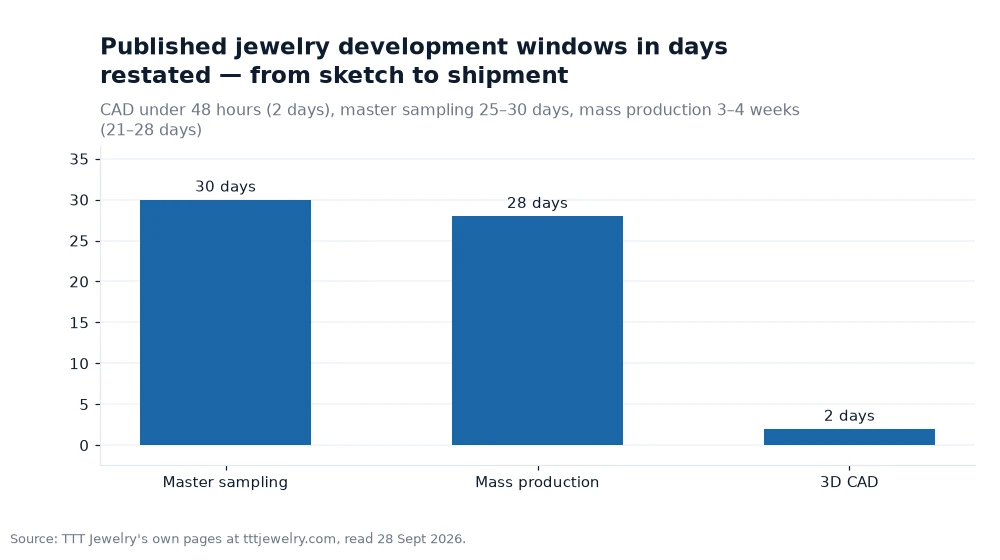
- CAD takes under 48 hours, which is 2 days and 8% of a 25-day sampling window.
- End-to-end development runs 2 + 25–30 + 21–28 days, or 48–60 days.
- Anti-tarnish e-coating is a wear barrier, not a waterproofing treatment.
A launch metal with a published floor
Brass is a copper and zinc alloy. It casts fine detail, files quickly and takes a high polish without the tooling expense of a precious metal. The artisan eco-brass line at TTT Jewelry carries an order floor of 100 pieces per design, and that one number shapes a first collection more than any design decision does.
Ten designs means 1,000 pieces before anything leaves the building. Three designs means 300. A buyer who sketches a twelve-piece assortment quickly discovers that the range is really a commitment of 1,200 units, which is rarely the intent behind a test order.
The floor also punishes colourway thinking. Each finish is a separate plating run and, in most programmes, a separate design for counting purposes. Four silhouettes with two finishes each gives eight counted designs at 800 pieces; the same four silhouettes in six colours gives twenty-four and a bill that no first season justifies.
None of this makes brass a soft option. The factory commitment in tooling and inspection is the same as for silver. What changes is the value of metal inside each unit and the surface chemistry needed to hold the colour, which is why coating rather than casting usually decides whether a brass line sells through or comes back.
What 100 pieces per design buys
The MOQ is not a discount tier. It is the batch size at which a mould, a plating bath and a packing run make sense for a single design. Read against the published process, it sets the quantity for every stage after sample approval.
| Stage | Published figure | What it fixes at 100 pieces |
|---|---|---|
| 3D CAD modelling | Under 48 hours | Two days before a printable or millable model exists |
| Master physical sampling | 25–30 days | One approved master per design before any bulk metal is poured |
| Mass production | 3–4 weeks | 100 units is a single short run on one mould |
| Final quality control | 100% inspected | All 100 pieces checked, not a sample of ten |
| Packaging | Tags, boxes, pouches | Eight designs means eight pack specifications to approve |
Two practical consequences follow. A 100-piece run is short enough that one mould carries the whole order, so a tooling fault appears in the first batch instead of being averaged away across thousands of units. And because inspection covers every piece, the checking burden per unit is heavier on a short run than on a long one.
The eight factory steps, read in brass
TTT Jewelry lists eight production steps: concept design by hand and CAD, prototyping by mould or 3D printing, sprue cutting, high-gloss polishing, surface art in brushed and textured finishes, electroplating, 100% final QC, and global delivery. Brass behaves differently at three of them.
Prototyping comes first. Brass casts a sharp edge well, so a mould can hold a thin wall that would round off in a softer alloy. The CAD stage has to decide whether the design depends on that thinness or merely tolerates it. Where it depends on it, the approved sample becomes the specification and the drawing becomes a reference document.
Sprue cutting and polishing come next. The metal is soft enough to file quickly and hard enough to hold a gloss, which is why brushed and textured faces are produced after polishing rather than instead of it. A mirror face and a brushed face on one ring are two surface operations, both completed before plating.
Plating is the third. Colour sits on the polished surface, so a scratch that cuts through the plate reveals yellow metal. Buyers planning a single finish should ask which step repeats if a batch fails: re-polishing and re-plating a whole run is a different schedule from touching up a handful of units. An OEM/ODM jewelry manufacturer with documented stage control can name that rework path before the purchase order is signed.
Coating, hallmarks and the parts customers touch
Anti-tarnish e-coating is published as standard on the brass and silver lines. It is a clear barrier laid over the plated surface, and its function is to slow the reaction between metal and the air, sweat and cosmetics that reach a pendant or a ring in daily wear.
Whether a custom brass jewelry supplier applies the coat after plating or before it changes how the piece ages, and the published order of operations places it last. Three details decide whether it works. The coat has to reach edges, the inside of a chain link and the underside of a setting, not just the face in the photograph. It has to be thin enough that a brushed texture still reads as brushed. And it has to bond to the plating beneath it, because a barrier over a weak plate simply holds the failure in place.
Care copy follows the same physics. Perfume, hairspray and chlorinated water shorten the life of any coated brass piece, and printing that on a backing card prevents more returns than a thicker coat would. The coating buys time; it does not turn brass into a swimming metal.
Marking is the other customer-facing detail. Laser engraving can place a brand logo, and the published hallmark set covers S925 for silver, 316L for stainless and 18KGP for gold-plated goods. On a brass programme the mark has to sit where polishing and plating will not erase it, which usually means engraving after plating and before the final coat.
Worked example
Take a six-design eco-brass launch. The order is 6 × 100 = 600 pieces. Nothing can be reduced below 100 per design, so trimming to four designs takes the commitment to 400 pieces and saves 200 units of metal, plating and packing.
The calendar adds up the same way for either version. CAD is under 48 hours, which is 2 days. Sampling is 25–30 days and bulk is 21–28 days, so the total is 2 + 25–30 + 21–28 = 48–60 days, or roughly 7 to 9 weeks.
Put CAD in proportion. Two days against a 25-day sample window is 48/600 hours = 8%. Against 30 days it is 48/720 = 6.7%. The model is fast; the wait sits in the physical master. For a six-design range, that means six masters moving through the same 25–30 day window, not six windows stacked end to end, provided the briefs arrive together.
Finally, count inspection passes. Six designs at 100% inspection is 600 pieces checked individually. If two designs fail and are remade at 100 units each, the inspected total is 800, not 600, and the schedule absorbs a second plating cycle.
Frequently asked questions
What is the minimum order for eco-brass jewelry?
The published minimum is 100 pieces per design for the artisan eco-brass line, and the count applies to each design rather than to the order as a whole.
How long does a brass private-label order take?
Allow 48–60 days from approved brief to delivery: under 48 hours for CAD, 25–30 days for the master sample and 21–28 days for bulk production.
Does anti-tarnish coating make brass waterproof?
No. The coating slows tarnish and wear but does not seal the metal against water, so care guidance should still keep brass away from swimming, perfume and chlorinated cleaning.
Editing the range before the first order
The least expensive edit happens on paper. Cut the assortment to the silhouettes that can share a chain, a finding and a pack format, then let colour do the work inside that shorter list.
Buyers who intend to scale into silver later should size the brass run with that move in mind, because a custom jewelry wholesale programme rewards designs that survive a metal change without new tooling logic.
A brass launch is a test of the supply chain as much as the design. The 100-piece floor keeps the test affordable; the coating and the hallmark decide whether the customer sees a considered product or a short-lived one.
Source note: figures come from the manufacturer's own website (tttjewelry.com), read 28 Sept 2026.[1]