
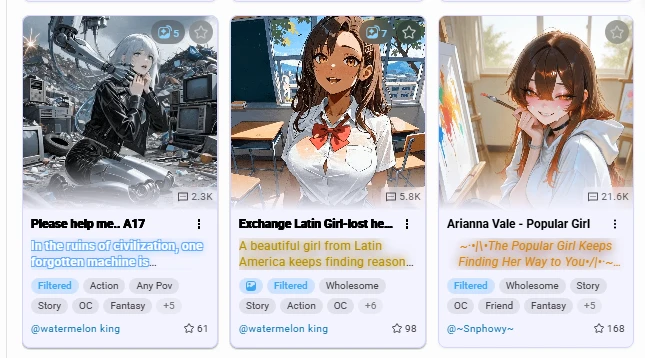
Users enjoy AI character chat with custom characters because these systems provide personalized conversations, creative freedom, and consistent interaction styles. In a 2024 survey of more than 2,000 AI companion users, personalization features ranked among the most requested functions, while platforms with memory and character settings reported higher user retention. Custom AI characters allow users to create personalities, backgrounds, and communication styles that match specific interests, from storytelling and entertainment to emotional conversations and role-playing.
AI character chat has grown because users no longer interact with AI only for information. They use it for conversations that feel more personal and flexible. Market research from 2023 estimated the global conversational AI sector at more than $10 billion, with entertainment and companion applications becoming some of the fastest-growing areas.
“A customized character changes AI from a general assistant into a personal conversation partner.”
The customization process plays an important role in user engagement. Most platforms allow users to define names, personalities, speaking patterns, hobbies, and fictional backgrounds. A character profile may include dozens of details, such as age, occupation, interests, emotional style, and relationship preferences.
For example:
| Character setting | User experience |
|---|---|
| Personality traits | Creates a recognizable communication style |
| Background story | Makes conversations more consistent |
| Speech patterns | Helps users identify the character |
| Memory features | Maintains previous conversation details |
A 2022 study on social chatbots with 300 participants found that users showed stronger attachment when the chatbot provided personalized responses instead of standard replies. The same principle applies to AI character platforms, where customization increases the feeling of familiarity.
The emotional side of AI character chat comes from how people interact with systems that display human-like communication. Researchers have studied anthropomorphism in digital assistants since the early 2000s, showing that users often respond more positively when technology uses friendly language, remembers preferences, and maintains a stable personality.
Custom characters increase this effect because users create the communication style before the conversation begins. Someone looking for a creative writing partner may build a character with a detailed fictional world, while another user may prefer a calm conversational partner with supportive responses.
A 2023 report from the AI companion industry showed that users spent an average of more than 30 minutes per day interacting with personalized AI characters on some platforms. Longer sessions were commonly associated with features such as memory, voice interaction, and personality customization.
The popularity of AI character chat is also connected with entertainment habits. Movies, games, and novels have traditionally offered fixed characters, but AI allows users to continue conversations beyond the original story. A fictional character can answer questions, create new scenes, or participate in personalized storytelling.
“Interactive storytelling changes the relationship between audiences and fictional characters by allowing direct participation.”
This approach has become common among users who enjoy role-playing communities, fan discussions, and creative writing. In 2024, several AI platforms reported millions of character creations, showing that users are interested not only in chatting with existing personalities but also in designing new ones.
Custom AI characters are also used for practicing communication skills. Language learners, writers, and professionals can create specific conversation partners for training purposes. For instance, a user can design a character that speaks only in a target language or acts as a business discussion partner.
A small-scale study published in 2023 with 120 university participants found that conversational AI tools improved confidence during language practice sessions when users received immediate responses and personalized feedback. AI character chat provides a low-pressure environment where users can repeat conversations without social concerns.
The entertainment and communication functions of AI characters have also expanded into adult-oriented conversations. Some platforms provide private role-play experiences, including ai sexting, where users interact with customized characters based on personal preferences. These applications focus on fictional communication settings and user-controlled character design.
The growth of these platforms is supported by improvements in large language models. Modern AI systems can generate longer responses, maintain conversation context, and adjust writing styles according to user instructions. Between 2020 and 2024, language model development significantly improved response quality through larger training datasets and better instruction-following methods.
A comparison of traditional chatbots and custom AI characters shows clear differences:
| Feature | Traditional chatbot | Custom AI character |
|---|---|---|
| Personality | Usually fixed | User-defined |
| Conversation style | Standard responses | Customized communication |
| Memory | Limited or unavailable | Often includes user preferences |
| Purpose | Information tasks | Entertainment, creativity, companionship |
These differences explain why many users prefer character-based AI experiences. The interaction is not limited to completing a task; users can shape the personality and communication environment.
The design quality of a character also affects long-term interest. A simple description such as “friendly assistant” usually creates generic conversations, while detailed profiles with specific habits, motivations, and speaking styles produce more recognizable interactions.
Many platforms encourage users to create characters with structured information:
-
Personality: cheerful, serious, humorous, or analytical
-
Background: history, interests, and fictional details
-
Communication style: casual, formal, emotional, or direct
-
Conversation goals: learning, entertainment, storytelling, or companionship
A 2024 analysis of AI character communities showed that characters with detailed profiles received significantly more user interactions than basic profiles. Some popular characters accumulated hundreds of thousands of conversations because users found their personalities consistent and engaging.
AI character chat also provides users with creative control. Instead of consuming a fixed story, users can develop scenarios, modify character behavior, and explore different conversations. This approach combines elements from gaming, writing, and social platforms.
Future development will likely focus on stronger memory systems, voice communication, visual avatars, and personalized interaction models. In 2025, many AI companies introduced multimodal systems that combine text, images, and audio, allowing users to communicate with characters through multiple formats.
The growing interest in AI character chat shows a shift in digital communication preferences. Users increasingly look for systems that adapt to their interests, remember previous conversations, and support creative interaction. Custom characters provide a flexible format where technology and personal imagination work together to create more engaging conversations.